
Your trading bot needs enough money to trade tomorrow. Your finance team needs to pay a supplier today. Neither task should give a compromised laptop a path to the rest of the company’s reserves.
Separate wallets may still share an administrator who can change every policy. Two payment approvers may both rely on an address pasted into Slack. I’d check these shared points of failure before treating the reserves as protected.
When I look at crypto treasury security for a trading firm or a protocol team, I want to understand those paths. Where would a compromise start, and how much could it reach before someone intervenes?
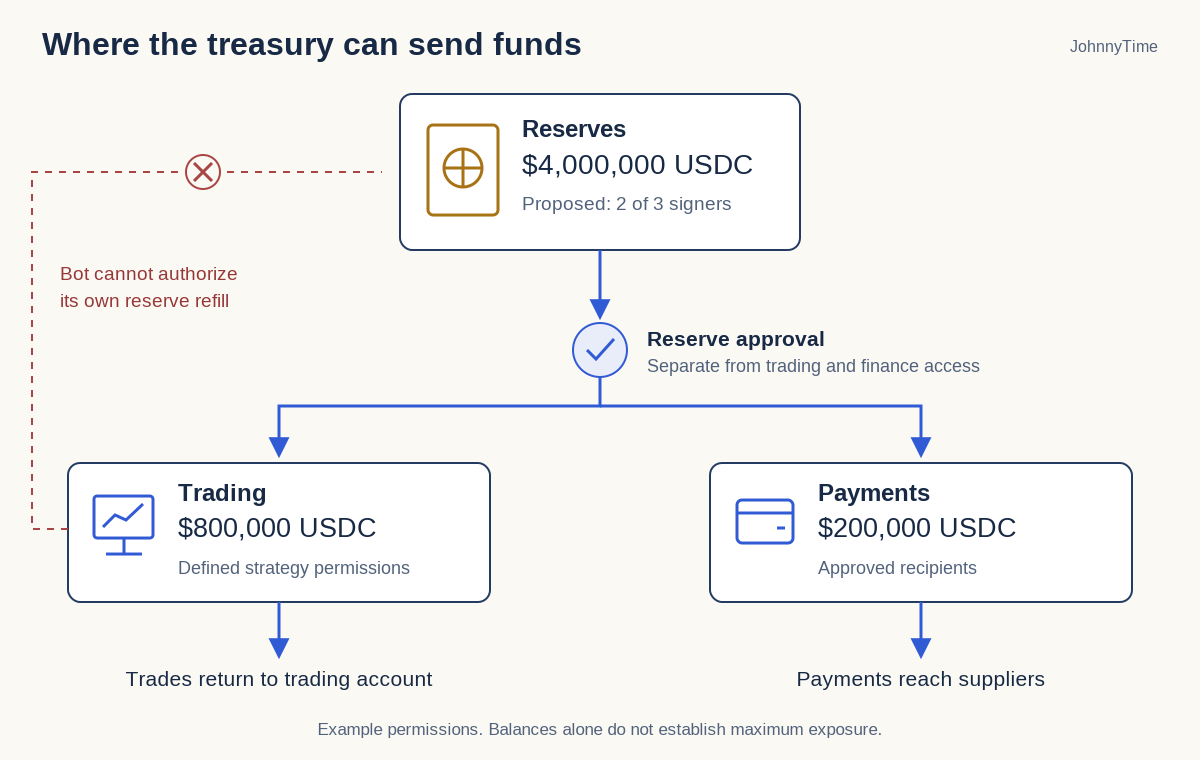
Take a company with $5 million in USDC: $4 million in reserves, $800,000 for trading and $200,000 for operating expenses.
Give each account a job
I’d keep the reserve account out of routine DeFi activity, with transfers restricted to approved company accounts.
For this company, I’d propose that reserve transfers need two of three independent signers. Trading access would permit the intended strategies with defined destinations and limits. Finance could pay approved recipients within its agreed authority.
If the trading process can pull another $800,000 whenever its balance falls, the balance provides little protection against repeated withdrawals.
I’d make reserve refills a separate decision. A person outside the trading system would review the request and the destination before the required signers approve it. Any automated refill would need its own enforceable total limit and review of who can change it.
I’d record each account’s chain and asset, check its permissions on that network and keep gas available for an emergency transaction.
Find the person who can change the rules
Separate accounts can share a weakness. Imagine that the trading operator also controls the administrator account that changes destinations and spending limits.
An attacker who takes over that administrator may be able to approve a new destination before moving funds.
I’d trace the authority to add recipients or replace approvers, including control of the recovery account. Then I’d check whether one person’s compromised email account or laptop could give an attacker several of those roles.
For a multisig account, I’d verify the owners and threshold directly onchain at a recorded block. Then I’d inspect enabled modules and other account extensions. Safe’s module documentation explains that modules add execution paths alongside its owner-signature mechanism. Its help article gives an example where a module allows one administrator to control an otherwise three-of-five account.
For an MPC arrangement, I’d ask which parties or devices hold signing shares and which approvals the service requires before using them. MPC, or multi-party computation, lets participants cooperate to sign using key shares.
I’d review its active transaction policy separately. For example, Fireblocks documents policies for initiators, sources and destinations, and distinguishes drafts from published rules. I’d inspect the published rules in the company’s workspace.
I’d test that the active signing policy rejects an unapproved recipient.
Follow one supplier payment
Suppose finance requests a $25,000 USDC payment. The supplier has emailed a new address.
I’d pause the payment until someone verifies that change through a trusted contact method already held by the company. Calling the number in the same new email would leave the verification dependent on the message we’re questioning.
Once the recipient is confirmed, the request should identify the chain, token contract and amount. The approvers need a way to compare the transaction with those details. A familiar token symbol or an address ending in the expected characters is too easy to misread.
For a contract interaction, I’d decode the call and simulate it with the relevant account state. I’d inspect resulting balances and allowances, including any transfers inside a batch. I’d refresh the simulation if relevant state changes before signing.
The person approving should see the same transaction that will be signed. I’d avoid a workflow where an operator can replace the payload after the review.
| Action | Proposed responsibility | How I’d check it |
|---|---|---|
| Request the payment | Finance supplies the payment details | Compare the request with the decoded transaction |
| Approve a new recipient | A separate person verifies the supplier | Review the recorded confirmation and test the destination rule |
| Authorize movement | Required signers review and sign | Test that insufficient approval cannot execute |
| Reconcile the payment | Finance checks the confirmed result | Match chain, token, recipient and amount to the request |
The supplier call verifies the address. A separately controlled recipient list can require that verification before the wallet will sign a payment. I’d record which restrictions the wallet actually enforces.
Choosing how the treasury approves transactions
For our reserve and trading accounts, I’d compare how each setup enforces the permissions we just described. These options differ in where approval happens and who must operate it.
| Tool or system | Where it helps | What I would verify |
|---|---|---|
 Fireblocks Policies |
Workspace rules for initiators, sources and destinations | Inspect the active policy and publication permissions. Reject a new supplier address and test who can authorize its addition. |
 Safe |
Onchain owner thresholds with optional modules | Read owners, threshold and enabled modules. Test alternate execution paths and recovery when one owner is unavailable. |
 Tenderly Simulator |
A separate check of the payment or contract call | Use the exact account, payload and block. Inspect transfers and allowances. Confirm approvers sign the same request. |
I’d consider a managed policy workflow when finance needs centrally administered transaction rules. Safe suits teams prepared to operate their own onchain signing arrangement and inspect its extensions. Simulation can support either setup.
The treasury owner still needs trained signers, a backup administrator, policy-change reviews and recovery drills. I’d include that work in the purchase decision. These documented features haven’t been tested in a provider tenant for this article.
Decide what the trading system can lose
Our trading account starts with $800,000. I’d look at the positions it can create as well as the tokens sitting in the wallet.
I’d check borrowing authority, collateral and connected exchange accounts before treating $800,000 as a loss boundary.
The ERC-20 standard lets an approved spender move tokens within its allowance without another wallet signature. Removing a trader’s application access leaves that allowance in place until it is changed onchain or otherwise ceases to apply.
I’d list spenders and check the amounts they can take. Where the strategy permits it, I’d reduce allowances to what it needs and test the resulting trade flow. The wallet-policy article follows recipient restrictions and allowances in more detail.
I’d also test repeated and concurrent refill requests against the aggregate limit, including its reset period.
A signer is compromised on Friday evening
Now assume one reserve signer reports that their device has been compromised. The other two signers are available.
In the proposed two-of-three account, the remaining pair should be able to authorize replacing the compromised owner. I’d verify that transaction path and the resulting threshold before relying on it. Safe’s removeOwner reference is one implementation’s interface for this change.
I’d stop routine refills while the response team checks pending requests and other access held by that person. That might include API credentials or the ability to change the recipient list. Replacing a signing key addresses only the authority tied to that key.
I’d also inspect outstanding signed orders and permit messages, using their own validity and cancellation rules.
Before normal activity resumes, I’d read back the current owners and permissions through an independent interface. I’d check for unexpected transfers, review allowances and verify the replacement signer with a controlled low-value transaction.
An incident may require moving assets to a fresh account. I’d establish who can authorize that move, which address is trusted and how the destination is verified before the team faces the decision under pressure.
Keep the account list useful
After the exercise, I’d keep one account register with named owners and the next review date. It would include the actual limits and the last successful recovery test. Private keys and recovery secrets belong in their approved storage, outside that register.
I’d revisit it when a signer leaves or a strategy gains a new permission. I’d repeat those checks after a custody-provider change or adding a network. Finance should reconcile expected transfers against confirmed results, and alerts should reach someone who can act when a policy or owner changes.
The monitoring article covers how to test that response path. For a treasury, I’d include an unexpected transfer and a change to signing authority in the exercise.
You can use the treasury responsibility and recovery worksheet to map your accounts and rehearse a loss of access. If you’d like help reviewing who can move your company’s funds, get in touch about a treasury security review.