
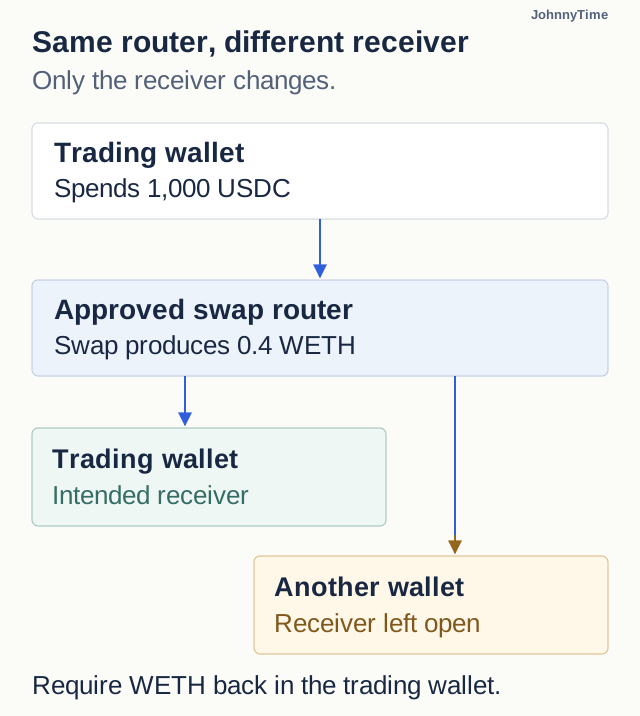
A trader swaps USDC through the approved router. The wallet pays, the swap succeeds, and the WETH goes to another address.
The trade can satisfy a policy that checks the router and amount but leaves the recipient unrestricted. I’d test that field before giving the trading team permission to use the wallet.
The due-diligence article raised the question of who can move assets. This swap example turns the intended permission into requests the policy should allow or block.
The trade we want to allow
Let’s say a trading team wants to swap 1,000 USDC for WETH on Ethereum using an approved Uniswap v3 router. WETH is wrapped ETH, a token form of ETH. The proceeds should go straight back to the trading wallet.
An authorized trader can propose the transaction, but two separate people need to approve it. For this example, the quote is 0.4 WETH, the minimum acceptable output is 0.396 WETH, and the request expires after two minutes.
Here’s a first attempt at the signing policy:
Allow an authorized trader to:
  use the trading wallet on Ethereum
  call the approved Uniswap router
  use the single-swap method
  spend up to 1,000 USDC to buy WETH
  keep the reviewed minimum output and deadline
Block other actions.
The first test looks good. The second one doesn’t.
I would start with the transaction the team actually wants: swap 1,000 USDC and send the resulting WETH back to the trading wallet. The policy allows it.
Now I would copy that transaction and change just one thing: send the WETH to another wallet.
The router, assets and amount are unchanged. The policy still allows the swap to the other wallet.
This is possible because the contract being called and the address receiving the tokens are separate fields. Uniswap v3’s single-swap interface calls the latter recipient. You can see how it is passed into the swap in the router implementation.
The fix is to add the missing condition:
 Keep the existing swap conditions.
+Require recipient == trading_wallet_address.
Then I would run the two transactions again. The intended swap should still pass. The swap to another wallet should be blocked. I would also try a transaction whose receiver the custody system cannot decode. If it cannot establish where the WETH is going, I would expect it to block the request.
| Test transaction | Before the change | After the change |
|---|---|---|
| Swap back to the trading wallet | Allow | Allow |
| Same swap, different receiver | Allow | Block |
| Receiver can’t be decoded | Block | Block |
I’d also check how the custody system decodes the assets and receiver, and whether it restricts the method to a single swap rather than a batch.
Could another rule still let the wrong receiver through?
The rule that gets there first
Imagine the team already had an older rule allowing this wallet to call the router. The new receiver restriction has been added underneath it:
1. Allow calls from this wallet to the router.
2. Block swaps that send output elsewhere.
3. Allow the narrowly defined swap.
4. Block everything else.
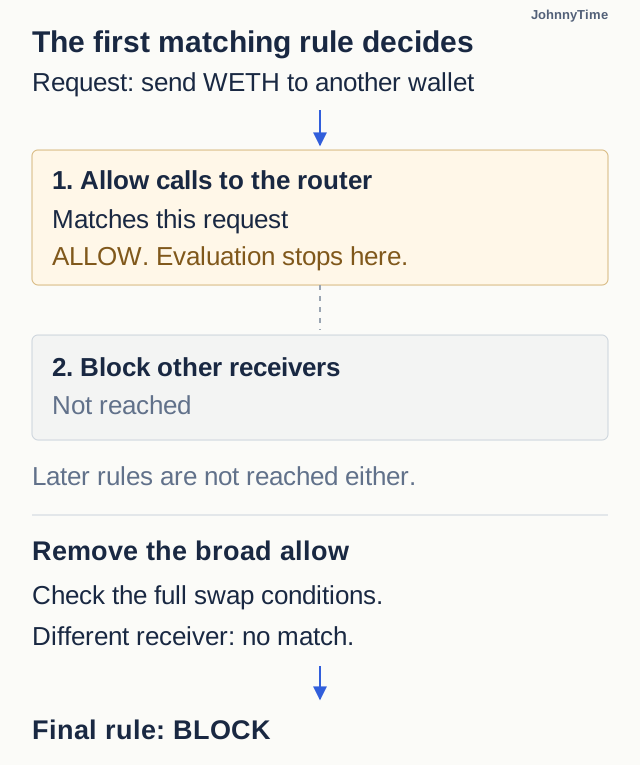
I would remove the broad permission or replace it with the full set of swap conditions. Moving the receiver block above it could stop this particular transaction, but the old rule might still allow a different asset, method or batch call. I would test those too, and keep the rule ID and evaluation trace for each result.
Fireblocks documents first-match policy examples and evaluation in defined order. I’d check the product’s actual priorities and exceptions before applying this model to an account.
The permission that stays after the swap
There is another transaction hiding behind our trade: the token approval.
Before the router can spend USDC, it generally needs an allowance. That is permission to take tokens from the wallet. The approval is a separate transaction from the swap itself.
Suppose the wallet holds 50,000 USDC, but the trader asks for an unlimited allowance to make the 1,000 USDC trade. If approved, the router has spending authority over the USDC balance, subject to its code. Our 1,000 USDC swap limit does not shrink that allowance. After the trade, another 49,000 USDC remains in the wallet.
For this example, I would start with a confirmed zero allowance and allow an approval of exactly 1,000 USDC to the approved router. Then I would test an amount one smallest token unit higher and an unlimited approval. Both should be blocked. The team should also be able to set the allowance back to zero and revoke unused permission.
I would check this transaction separately because it calls the USDC contract and names the router as the spender. A rule that only recognizes the router as a destination does not cover it. The ERC-20 specification describes allowances and the risks of changing a nonzero approval. After the swap, I would read the remaining allowance instead of assuming it has been consumed.
Existing approvals matter too. So do other ways of granting spending permission. An ERC-2612 permit, for example, can change an allowance through a signed message. Blocking a direct approval transaction does not establish that every other route is closed.
There is one more question for the team: is 1,000 USDC a limit per trade or a total budget? A per-trade limit can still allow the same trade repeatedly. If the intention is a total budget, I would test that control across simultaneous requests and resets.
The signing service is another part of this picture. In my signer security article, I follow what a compromised bot can ask a key to sign and how to limit its access.
Who can make the request?
The authorized trader should be able to propose the swap. An account without that permission should not. If the request comes through an API, I would verify which identity the credential actually represents. A field in the request saying “authorized trader” is not enough.
Then I would test the two approvals. One should not be enough. The same person should not count twice. In this example, the trader proposing the transaction should not fill either independent approval role.
I would also change the receiver after the first approval and check that the earlier approval no longer counts. Both people need to approve the same transaction, including its chain, wallet, router, value and complete encoded instruction.
And who can change the policy? Someone who can add a broad allow rule, change group membership or enroll another trading credential may be able to give themselves more access. I would review how those changes are authorized, and map any other signing or execution routes the team can use.
What would actually happen on-chain?
Let’s say the request passes the policy and has the right approvals. I still want to see what it is expected to do before signing.
A simulation runs the transaction against a particular blockchain state without broadcasting it. For our swap, I would look for 1,000 USDC leaving the trading wallet, at least 0.396 WETH arriving back, and the remaining allowance. I would also look for unexplained transfers or new spending permissions.
The simulation has to match the transaction being approved. A result for an earlier quote or a different wallet doesn’t establish what this request will do. The calldata, the encoded instruction sent to the contract, must match too. I would keep the decoded transaction, policy revision, chain, block reference, code identities, starting balances and allowances with the result.
If the simulation is missing, reverts, is too old or leaves a relevant balance change unexplained, I would hold approval until a fresh simulation explains the expected balance and allowance changes. Changes to prices, code or permissions before execution may require a fresh simulation and approval.
Which system can enforce this swap?
Our receiver condition is a requirement to take to a provider. I’d ask them to show the exact field and execution path that enforce it. The products below offer different parts of that workflow.
| Tool or system | Where it helps | What I would verify |
|---|---|---|
 Fireblocks Policies |
Ordered transaction policy rules | Confirm whether the selected rule type decodes and restricts the router recipient. A destination rule alone does not establish that. Re-run the broad-rule case. |
 Safe guards and modules |
Custom checks in an onchain account | A guard can add checks around transactions. Inspect the deployed guard and every module path, including which restrictions each actually applies. |
 Tenderly Simulator |
Checking expected token and allowance changes | Simulate both receiver cases with identical starting state. Keep the payload and block with the result. |
I’d shortlist based on a demonstrated rejection of our forbidden swap. Fireblocks’ documented policy ordering is useful implementation context. A Safe control needs review of the actual contracts and enabled routes. Tenderly can help inspect the expected outcome, while signing authority remains with the wallet system.
The policy owner needs to repeat the cases after a rule, router or module change. A product name on the account doesn’t establish that the active rules protect the receiver. This comparison uses documentation rather than a live custody-policy test.
Taking the tests to the real account
These example decisions still need testing against the active custody account.
Before relying on a real setup, I would compare an export of the active policy with the reviewed rules, including their order, inherited permissions and exceptions. Then I would run the positive and negative cases through the custody product’s supported test or sandbox workflow with the actual wallet identities, contract addresses and encoded transactions. I would record the decision and the rule that produced it. There is no need to broadcast an unwanted payment to test a restriction.
I would also return to the execution paths we mapped earlier. Can the trader sign directly, use a session key or reach the wallet through a module or recovery route? Safe modules, for example, can execute transactions using their own validation logic. Each path needs to enforce the trading restriction or have a separately reviewed authorization the trader cannot bypass.
If the active policy rejects the forbidden requests, independent approvals work, other execution paths are accounted for and a fresh simulation matches the intended funds flow, I would be comfortable approving this narrow swap permission. An unexplained allow, a bypass or missing test results would keep signing on hold. If the policy or signing paths change later, I would review them again.
Try the tests yourself
The 15 cases include inputs, expected decisions and the checks still needed.
Download the test cases as JSON or get the readable version. Replace the aliases with identities verified in your custody system, then record the actual result and the rule that decided it. The files use receiver for the router’s recipient argument.
If your team would like help reviewing its wallet permissions, let’s discuss a wallet-policy review through my security advisory service.