
At about 20:05 UTC on October 29, funds began leaving Binance wallets across multiple blockchains. Most of the main outflow happened in roughly twenty minutes, according to TRM’s investigation.
Binance’s estimated impact: $6.3 billion.
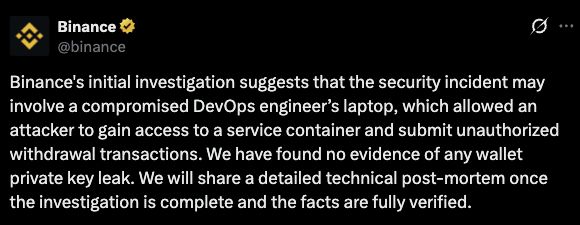
As a DeFi security engineer, the detail that caught my attention was its preliminary explanation: a DevOps engineer’s laptop may have opened a route into a service container and unauthorized withdrawals. Binance said it had found no wallet private-key leak. Binance’s announcement
That’s a frightening possibility. An attacker may be able to use a company’s signing system without taking the keys out of it. The systems meant to move money for the business become the route used to drain it.
I followed the public reports from the compromised devices to the Ethereum authorization and the response that followed. I wanted to understand where access to an employee’s computer could become permission to move funds, and what could still stop the attacker.
Updated 4 November 2026 with Binance’s November 3 initial findings. The investigation and independent review remain ongoing.
Where things stand
Binance’s November 3 report puts the impact at approximately $6.34 billion, with about $2.85 billion frozen or intercepted. It says enough funds have been set aside to cover the full loss and reports 98% of the affected token assets replenished as of October 31. These are Binance’s figures, subject to reconciliation and price changes. Initial findings and response update
Withdrawals began reopening at 06:00 UTC on November 1. Binance says all 15 networks in the initial phase were available by 12:36. Availability still depends on the asset and network. Withdrawal update
The timeline we can reconstruct
The table combines Binance’s public response with the transaction chronology reported by investigators. All times are UTC. A transfer timestamp tells us when a transaction happened. It doesn’t tell us when Binance’s staff first saw an alert.
| Time | Reported event | Source |
|---|---|---|
| October 29, about 20:05 | The main cross-chain outflow begins, according to TRM. | TRM investigation |
| 20:20:59 | An Ethereum transaction installs a delegation on Binance 14. | Bitquery chronology, transaction |
| 20:24:23 | The major Ethereum sweep executes. | Bitquery chronology, transaction |
| 21:01 | Bitquery records Tether’s first freeze on the main Ethereum receiver. | Bitquery chronology |
| 21:04 | Circle freezes the USDC in the main receiver, according to Bitquery. | Bitquery chronology |
| Around 23:05 | TRM reports a later wave on Avalanche and Polygon. | TRM investigation |
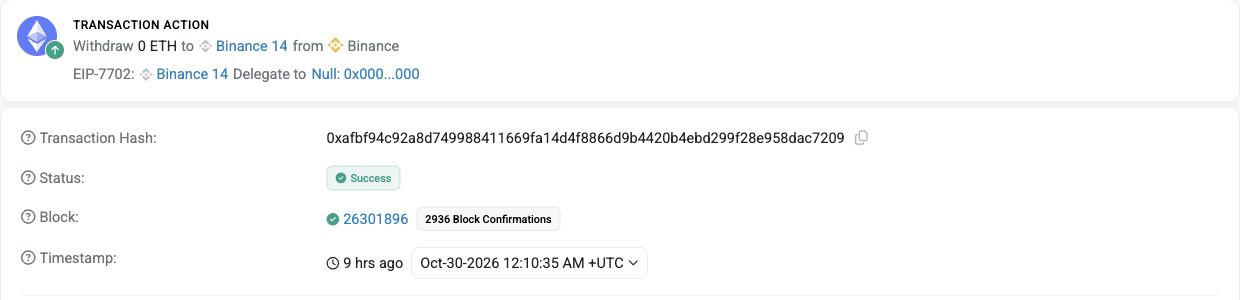
| October 30, 00:10:35 | Bitquery identifies the Ethereum delegation revocation transaction. | Bitquery chronology, transaction |
| 00:18 | Bitquery records Arbitrum Security Council action to lock the attacker’s ARB and ETH. | Bitquery chronology |
| November 1, 06:00–12:36 | Binance says withdrawals resumed across the 15 networks in its initial phase. | Binance withdrawal update |
Transaction interpretations are attributed to Bitquery. I have not independently replayed them. Binance also reported initially suspending deposits and withdrawals and engaging investigators, without publishing the internal action times.

How the attacker reached the signing service
Binance’s November 3 account describes a campaign across several employee devices. It began months before the drain.
In June, a Wallet DevOps engineer downloaded a tampered Homebrew installation while trying to install an AI coding tool found through a search engine. Binance says it detected the compromise, replaced the device and rotated credentials. The attacker had already learned about the engineer’s role and colleagues. The report leaves the connection between that exposure and the later recruitment approach unexplained.
In September, another engineer was approached through a job platform and went through two fake interviews. Near the end of the second, he downloaded an assignment onto his work computer. Binance says malicious code ran during setup and replaced a legitimate pyenv component, giving the attacker a way to execute commands and contact an external server.
On October 20, the attacker used that compromised computer and an internal AI tool to gain control of two wallet engineers’ devices. One held a container deployment token. Binance hasn’t explained how the internal tool was used or which permissions let it reach those devices.
On October 29, between 17:15 and 19:56 UTC, the attacker used one engineer’s computer and credentials stolen from another to deploy a container and trigger the attack. Binance says the resulting transactions went through its internal signing service outside the normal withdrawal process.

The deployment token is the detail I’d follow next. A compromised work computer could supply credentials for a deployment that reached wallet signing operations. Which independent check should have stopped that deployment or refused the request?
A valid signature alone cannot answer who was entitled to request it. A signing system can protect a key while accepting a request that the business would never approve.
The malicious downloads explain how the attacker got in. I’d also want to know what limited each device’s access after compromise, and why the deployment credentials could be used from another employee’s computer.
The permission that kept the Ethereum wallet exposed
TRM describes an Ethereum-specific step: an EIP-7702 delegation changed the behavior of a Binance hot wallet. It reports prepared authorizations on Ethereum and ordinary signed transfers on the other affected chains. It also describes repeated sweeps as more funds reached the Ethereum wallet. TRM interprets the combined activity as a compromise of signing infrastructure. TRM technical assessment
EIP-7702 lets an ordinary Ethereum account authorize code deployed elsewhere to run as its own account logic. That code can act on the account’s assets. The delegation stays installed until replaced or cleared. Malicious delegated code can therefore allow later calls to move funds without a fresh withdrawal approval from the exchange. EIP-7702 specification
The setup shows how much preparation went into the Ethereum attack. Hypernative reports that an operator wallet was funded through Tornado Cash roughly 36 hours before the drain, followed by a test sweeper and then the contract used in the attack. The later transactions connect that funding to the attack.
At 20:20:59 UTC, the setup transaction carried 50 signed authorizations for consecutive account nonces, according to Hypernative. The multiple signatures accounted for the wallet continuing to process transactions. Hypernative says one matched and installed the delegation. Range and Elliptic also report 50 authorizations. I have not independently decoded the authorization list.
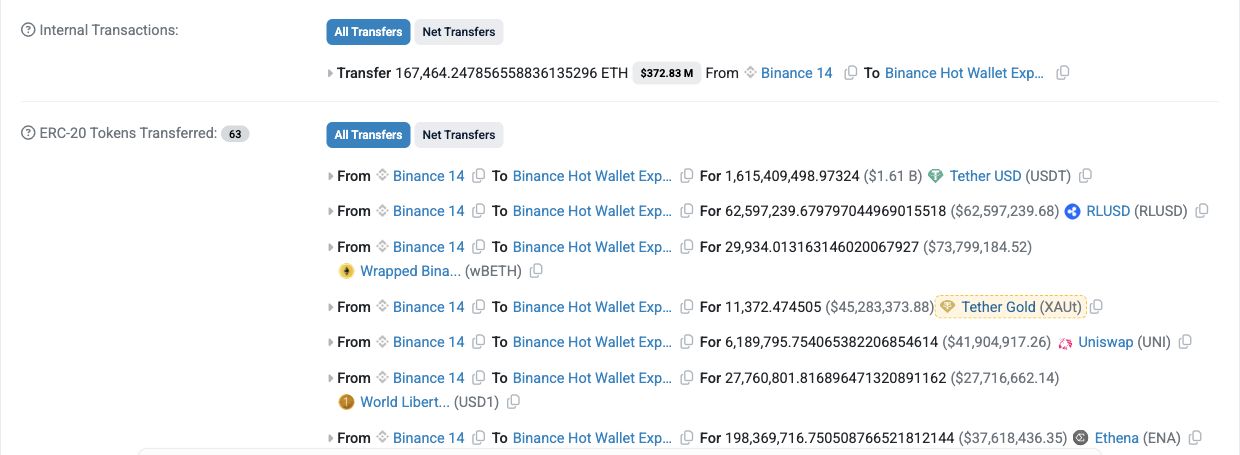
The first sweep followed at 20:24. Range reports that it moved 167,464 ETH and dozens of tokens. The delegation also exposed a connection beyond Binance 14 itself: Range reports that the attacker used its permission over a separate Binance smart account to pull 823 million USDC in two transfers. That extends the recovery task to every account and contract the compromised wallet can control.
Hypernative reports four further sweeps at 21:04, 21:44, 22:39 and 23:56 as funds continued to reach Binance 14. The delegation remained in place until the 00:10 revocation. I have not independently replayed those individual sweeps or established the source of the incoming funds.
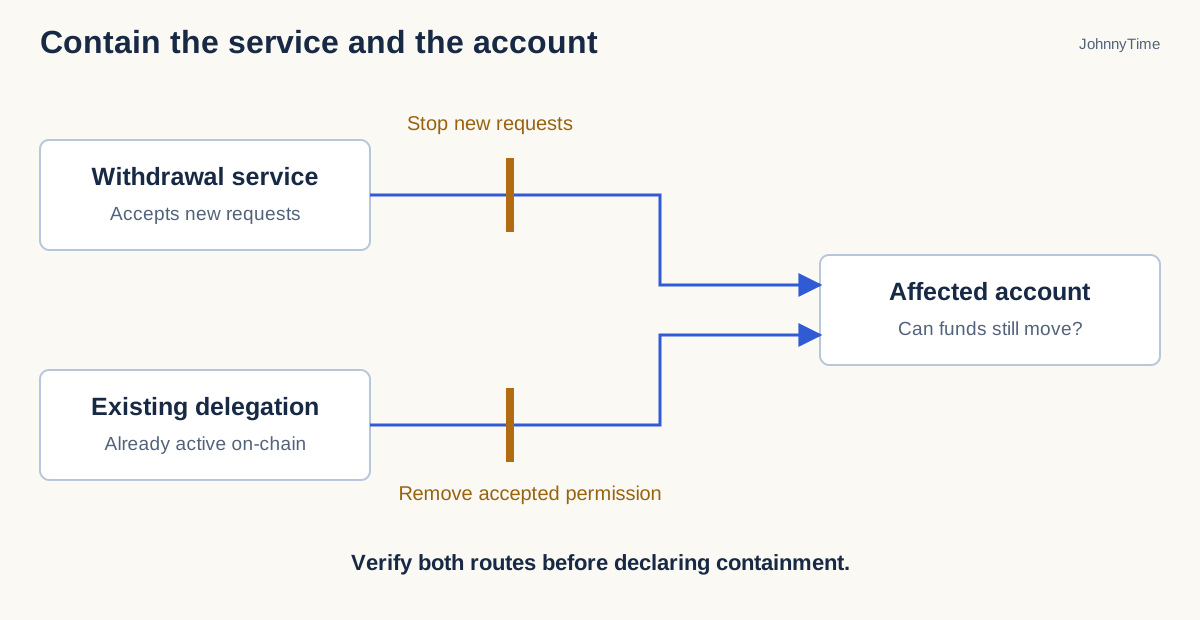
A team can stop its application from accepting new withdrawal requests while a permission already installed on-chain remains usable. The response therefore has to inspect both the service and the account’s current state.
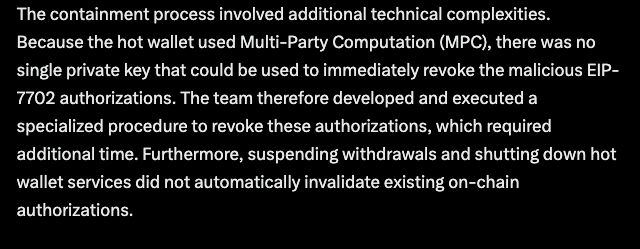
Binance says its MPC setup required the team to develop a special procedure to revoke the delegation, adding time to containment. It reports that the last unauthorized transfer finalized at 23:56 UTC, having already been broadcast, before the delegation was cleared at 00:10. Binance’s containment account
I’d want the revocation procedure ready before funding the wallet. The team needs to know who can approve it and how to submit it while the normal wallet service is shut down. That response should be rehearsed through the same MPC setup used in production.
The signer-security guide examines this boundary in more detail: what the process can request, what the signer permits and what the account or contract actually enforces.
Detecting the drain and stopping the next transfer
Blockaid says its detector flagged the drain 1 minute and 55 seconds after the sweep, with automated analysis within eleven minutes. This is the vendor’s reported performance. It does not establish when Binance received an alert or acted on it. Blockaid’s incident report
That gap is what I would want to understand in the response review: who received an actionable alert, what authority they had, and when their containment action took effect.
While Binance contained its own services and account permissions, responders also had to reach the issuers and exchanges able to restrict the stolen assets. Each handoff took time, and the attacker kept moving funds.
Bitquery’s review reports about $2.7 billion frozen under its methodology and cutoff, compared with Binance’s announced figure of about $3 billion. It describes the attacker swapping stablecoins before freezes took effect. Its holdings snapshot is dated 03:54 UTC on October 30. Bitquery’s tracing and methodology
Once stolen stablecoins reach an attacker, the race is to turn them into assets an issuer can’t freeze. Swaps are one route. Lending protocols offer another source of liquidity against the stolen tokens. Both were used here, across different wallets and overlapping windows.
Elliptic’s analysis traces 434 million USDT swapped for 160,451 ETH through Uniswap, 1inch and market makers. On Ethereum, this transaction shows an attacker-labelled wallet routing USDT through multiple pools at 21:09 UTC. In one leg, 10.68 million USDT entered a Uniswap V3 pool and about 3,391 WETH went to the router. Bitquery’s analysis estimates that the rapid buying pushed the main WETH/USDT pool’s minute-average ETH price 38% above its market reference. Liquidity was available, but speed and price impact came at a cost.
The attacker also used lending liquidity. Aave’s incident review traces 60 million USDT supplied as collateral and 19,762 WETH borrowed between 20:58 and 21:01. One supply transaction is part of that route. The collateral remained subject to the loan’s constraints and liquidation. The 20:58–21:01 borrow and the 21:09 swap show the attacker using both routes within minutes.
I’d want the response team tracing those routes as the funds moved. By the time an issuer freezes a receiving wallet, some of its tokens may already have bought ETH or secured a loan.
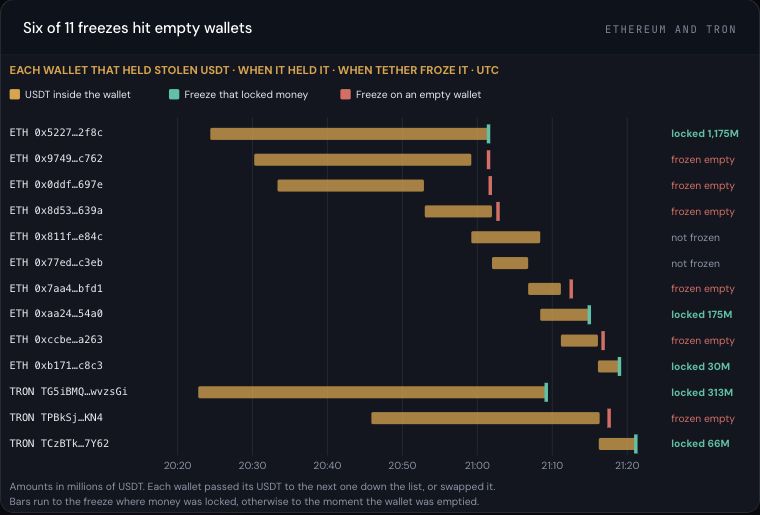
I’d read those totals with their timestamps attached. Prices move, investigators expand their address sets, and freezes happen at different times. Subtracting one investigator’s frozen total from another source’s impact figure would create a misleading estimate of final loss.
TRM counts ten chains. Bitquery counts nine. Their totals should retain their original scope and reporting time. TRM scope, Bitquery scope
Who was behind it, and how strong is the attribution?
The FBI and TRM attribute the attack to North Korea-linked TraderTraitor. On October 31, the FBI published its own attribution. TRM assigns high confidence, citing both on-chain and off-chain intelligence. Its public explanation points to advance preparation, pre-signed authorizations and funding patterns seen in earlier thefts. TRM’s assessment
AP also reports that Chainalysis CEO Jonathan Levin assessed TraderTraitor as likely responsible. Binance’s November 3 report also cites the FBI’s attribution. AP’s attribution reporting
The FBI had previously attributed the February 2025 Bybit theft to North Korea’s TraderTraitor actors. FBI’s Bybit notice
What the addresses let us inspect
I’d start with the roles of the addresses. A victim wallet, malicious contract and receiving wallet tell different parts of the story. The following Ethereum addresses are identified in Bitquery’s investigation. The links open their public explorer records. The role descriptions come from that investigation.
| Reported role | Ethereum explorer |
|---|---|
| Binance 14: affected wallet | View wallet |
| Code selected by the delegation | View contract |
| Attacker’s caller wallet | View caller |
| Main receiving wallet | View receiver |
The setup, sweep and revocation transactions are linked in the timeline above. Read together, those records help investigate which account executed code, where assets moved and when permissions changed. An explorer label alone cannot establish who controlled an address.
My assessment
The FBI’s attribution and TRM’s assessment point to TraderTraitor. My own reading of the public transactions supports a prepared operation with access to signing capabilities. Independently identifying the operators would require more of the funding links, device findings or infrastructure records behind those assessments. That material hasn’t been published in enough detail for me to reproduce the attribution.
What I’d want the final report to explain
Binance says it rebuilt the affected wallet system and internal AI tool, replaced affected devices and decommissioned the engineers’ credentials and tokens. It is also engaging independent security firms. I’d want that review to explain which controls now stop the same path.
| Question | Why it matters |
|---|---|
| How were untrusted installs isolated from work access? | Shows what prevented a downloaded assignment or installer from reaching production credentials. |
| How did the internal AI tool reach other employee devices? | Explains the permissions and connections the attacker used to move between them. |
| What restricted the stolen deployment token? | Shows whether device binding, deployment approval or workload restrictions could stop its reuse. |
| Which signing checks applied outside normal withdrawals? | Explains how transfers and EIP-7702 authorizations were approved, including any independent confirmation. |
| What triggered detection? | Shows whether the first actionable signal came from the endpoint, service, signer or chain. |
| What remained executable after the pause? | Identifies permissions and signed requests that survived the first containment action. |
| Was emergency revocation rehearsed through MPC? | Shows whether responders can clear a delegation while normal wallet services are unavailable. |
I’d also want the report to distinguish a control that was missing from one that existed but was bypassed or misconfigured. Each leads to different engineering work. Buying another product before understanding that distinction can leave the same route open.
What a crypto team can check today
Start with one employee role that can change production software. Trace its actual access to services that request signatures. Include emergency access and deployment identities, because a routine role review can miss those routes.
Then test the signing boundary with the process assumed compromised. Can it ask for an unexpected recipient, a larger amount or a delegation? Which independent component refuses, and does the refusal produce an alert someone owns?
Finally, rehearse containment with a permission already active on-chain. The exercise should force the team to reach the right signers, submit the authorized response and read back the resulting state. An alert in a chat channel is only useful when someone can perform that next action. The monitoring guide covers how to test the complete response path.
In a review, I’d test what a compromised developer account can make the signing system do. Then I’d test how the team removes permissions that are already active. Those are the two boundaries I want to understand before trusting the next withdrawal.